Written by: Malte Meuller, Advisor to the Chief Economist, SEB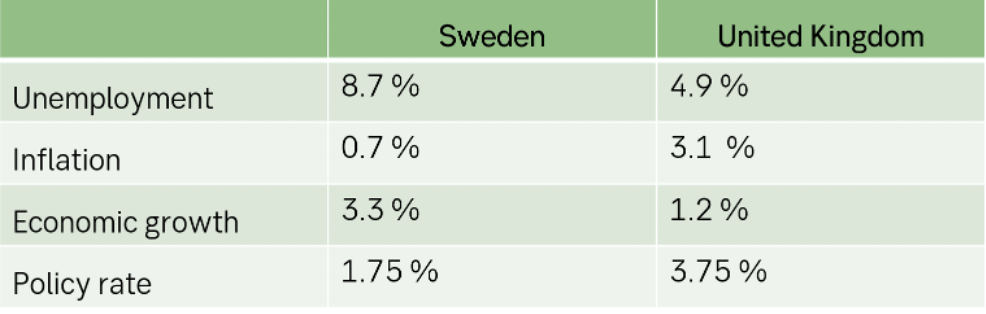
Business Outlook
Sweden and the UK enter the autumn from quite different economic positions. Swedish growth has accelerated, with GDP up 3.3% year-on-year in Q2, compared with 1.2% in the UK. Inflation also remains considerably lower in Sweden, while the policy-rate gap is wide at 1.75% versus 3.75%. Labour markets remain a weak spot in both countries, particularly in Sweden. In the UK, inflation rose to 3.1% in August and high government borrowing costs are adding to the pressure ahead of the 28 October Budget. Sweden, meanwhile, is entering a period of political transition following the closely fought general election.
UK-EU Political Discussions
Closer economic ties with the EU are becoming an increasingly important part of Prime Minister Andy Burnham’s agenda. Negotiations already cover areas including food and agriculture, carbon and electricity markets, youth mobility and access to European investment initiatives, while Burnham is also pushing for UK participation in the EU’s “Made in Europe” framework. For Sweden, further progress on services and reducing post-Brexit trade frictions would be particularly relevant given the already close commercial links between the two countries.
Closer collaboration and integration seems likely
Agreements reached: Trade and cooperation agreement, strategic partnership, security & defence partnership, eramus+, Horizon Europe
Ongoing negotiations: Food and agriculture, linking carbon markets, internal electricity markets, youth mobility, Scaleup Europe Fund
Deepens under Burnham? Service integration, European defence, Made in Europe
Swe – UK Trade
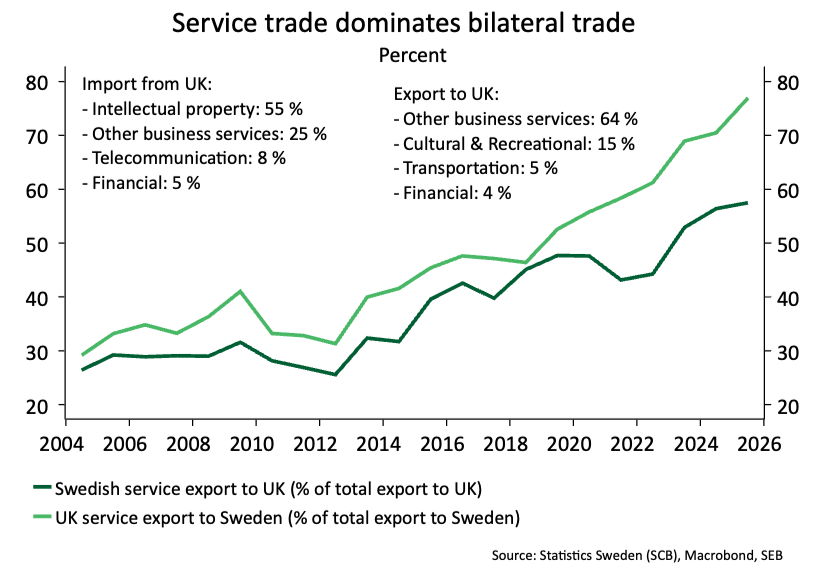
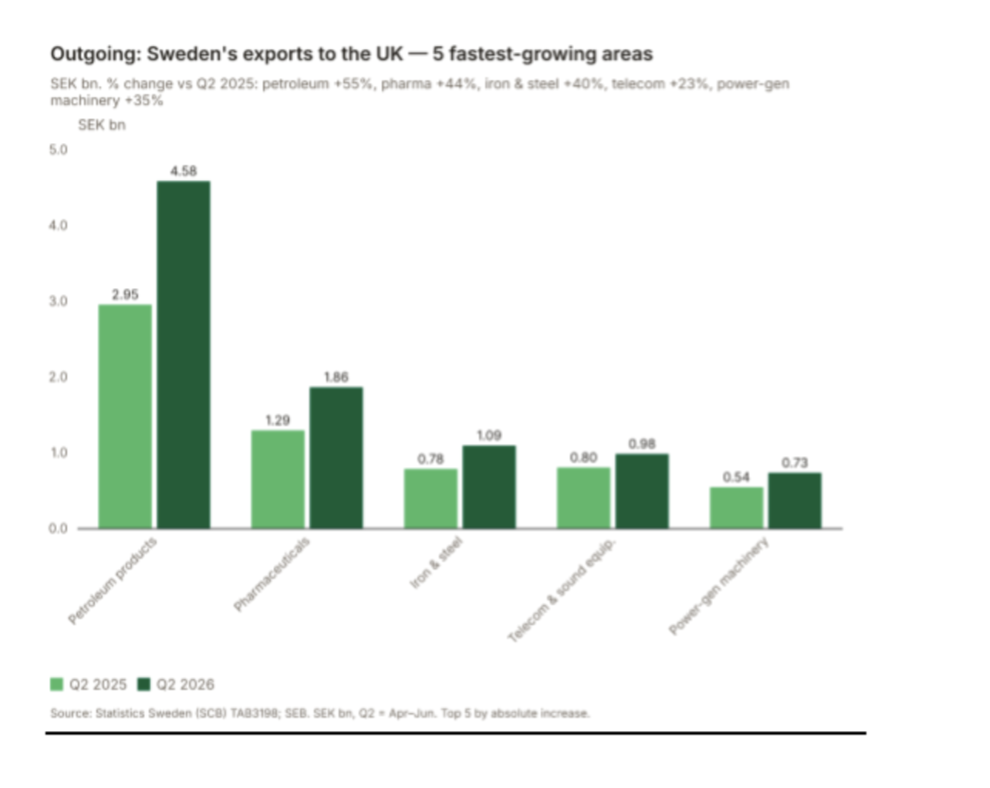
Goods trade is also showing strong momentum. In Q2 2026, some of the fastest-growing Swedish exports to the UK were petroleum products, pharmaceuticals, iron and steel, power-generation machinery and telecom equipment. The data therefore point to a relationship that is both broad and increasingly integrated, making further reductions in trade barriers potentially important for companies on both sides.
Burnham’s First Weeks
Burnham has been Prime Minister now for over a month. His agenda extends well beyond the initial cost-of-living measures, with ambitions covering welfare, housing, labour and defence. With fiscal headroom limited, the government is placing greater emphasis on structural reforms, including devolution, vocational training, private investment and closer EU ties.
The key constraint is financing, and delivering on the broader reforms will likely require some combination of higher taxes, spending restraint, additional borrowing or greater use of flexibility within the fiscal rules.
Due to the parliamentary majority, we propose three edge cases of how his premiership could look like.
1.) Worsening fiscal credibility with higher long-end gilt yields and weaker GBP.
2.) Stronger cost-of-living measures that lower inflation relative to current inflation swap pricing.
3.) Positive growth scenario driven by structural reforms favouring a flatter yield curve as well as stronger GBP and domestic equities.
A cautious start focused on the cost of living. The first measures include temporarily removing the 5% VAT on household electricity, followed by a £2 bus-fare cap from January 2027 and a 20% business-rates cut for pubs from April 2027. The measures are popular but relatively small, for example, the electricity VAT cut saves a typical household around £45 per year and lowers CPI by around 0.1pp.
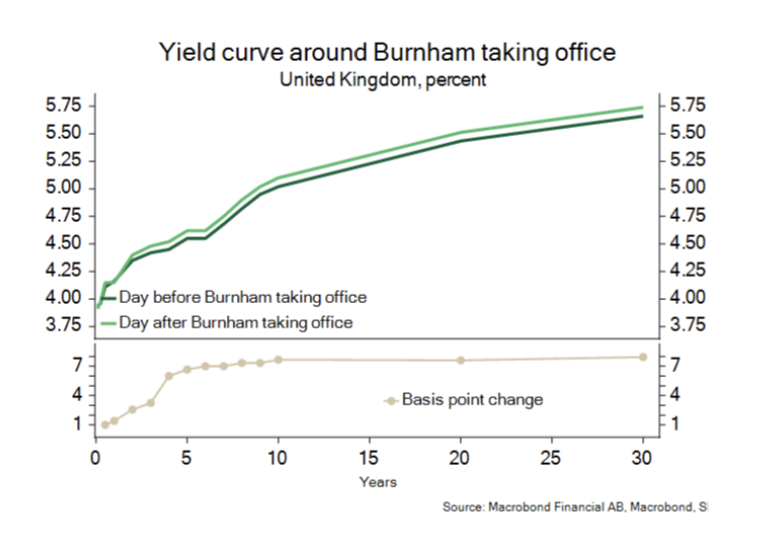
Despite being presented as fully funded, some of the financing was met with criticism as the money were taken from unfunded commitments. Chancellor John Healey's comment that the money "would have had to have been found" did little to strengthen that case. Burnham has also said that he will follow the fiscal rules while making use of the flexibility within them, initially adding to concerns in the gilt market. Long yields rose around 5–8bp in the first days. Small, but not trivial given the already high level. In total, the gilt markets have been calm and probably awaiting the October 28th budget.
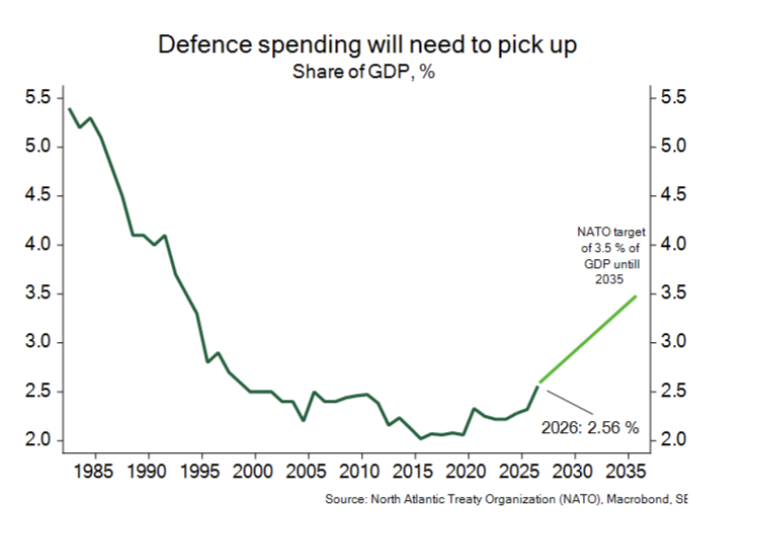
Long term commitments. Burnham has initially focused on expanding support for the elderly, people with mental health problems and the homeless. The government has also allocated £10bn for social and affordable housing, as well as boosting apprenticeships and vocational training to tackle youth unemployment. With former Defence Minister Healy as Chancellor higher defence spending seems likely. However, the spending commitment contains a gap of £5bn which needs to be funded over the coming year.
Structural reform over fiscal stimulus. With limited fiscal headroom, much of the emphasis is instead on structural change. The devolution agenda has already begun, with establishment of a second centre of government in Manchester, the "No 10 North". The reform agenda would include giving regions more control over their generated revenue as well as spending, especially tied to infrastructure. The educational system is also being looked over, to support local labour market needs with emphasis on vocational training.
On a general level, government procurement and public-private partnerships are expected to be used to incentivize private investment and support reindustrialisation. To increase the productivity, pension providers are exploring a £1bn-plus scale-up fund for high-growth UK companies. The positive EU-integration agenda has also continued, with Burnham pushing for closer economic relations. External estimates put the potential cost of his broader ambitions at roughly £45–65bn, or 1.5–2.0% of GDP, although much of this remains uncommitted.
Fiscal reality. Taken at face value, the agenda exceeds available fiscal headroom, implying that some combination of tax increases, spending cuts or additional borrowing will be required. Burnham has, so far, committed to Reeves’ fiscal framework: the stability rule, under which revenue covers day-to-day spending in the target year (currently 2029/30) and the investment rule, under which public-sector net financial liabilities must fall as a share of GDP in 2029/30 compared with 2028/29.
At the November 2025 Budget, the OBR put the probability of meeting the rules at 59% for the stability rule and 52% for the investment rule. The rolling target year gives the government some room to backload fiscal consolidation, i.e. borrowing more in the near term while pushing adjustment further out, as the Starmer government did in their last budget. Meanwhile, the OBR's March 2026 headroom of £23.6bn has probably been eroded by higher interest rates and a weaker economic outlook following the Middle East conflict, with estimates now closer to £10–15bn. At that level, even relatively small policy changes matter.
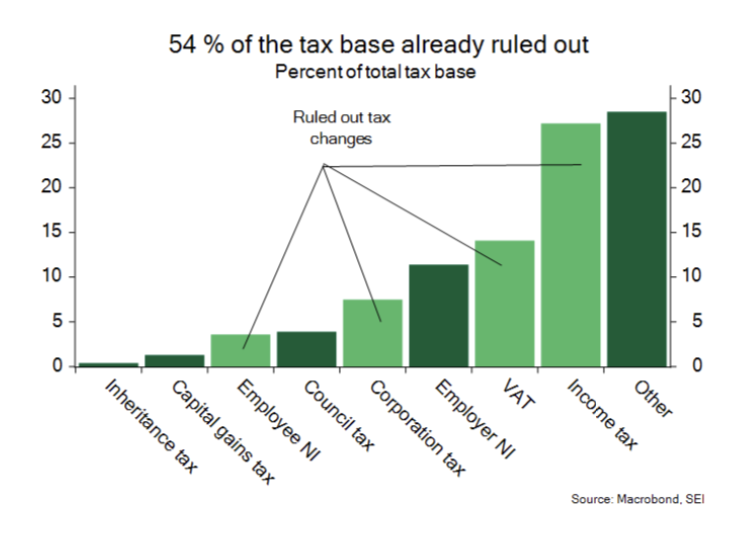
Burnham has also asked for "a bit more in tax" while ruling out increases in income tax, National Insurance, VAT and corporation tax, about 54% of the tax base. This leaves capital gains tax, a wealth tax, incremental tweaks to posts withing “other”, or by creating new taxes such as a "defence tax" (i.e. income tax), as possible changes.
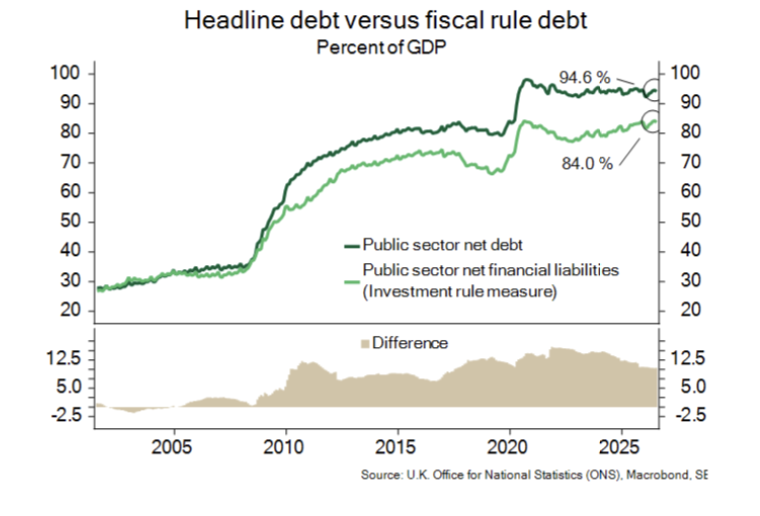
Burnham to use "any flexibility" in the fiscal rules. The investment rule is based on public-sector net financial liabilities rather than conventional public debt, allowing additional borrowing through public financial institutions without breaking the rules. However, markets ultimately focus on gross borrowing and debt sustainability and have little patience with unsustainable public finances or fiscal games.
Three Scenarios for the Future
With Burnham being backed by a large parliamentary majority, the range of fiscal outcomes during this mandate is unusually wide. We outline three edge scenarios, what could confirm them, and the potential market implications.
1.Worsening fiscal situation
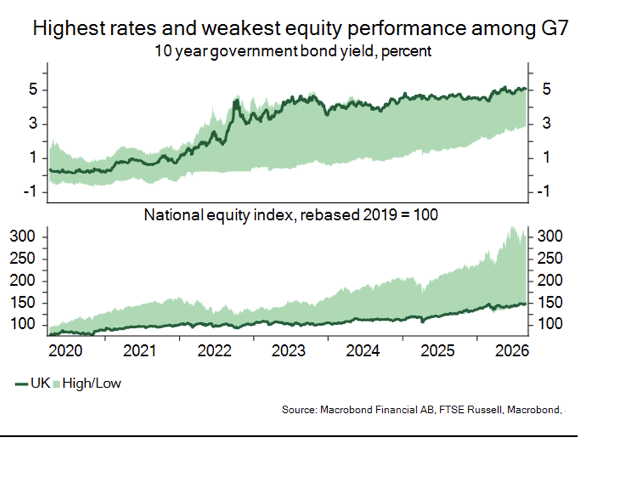
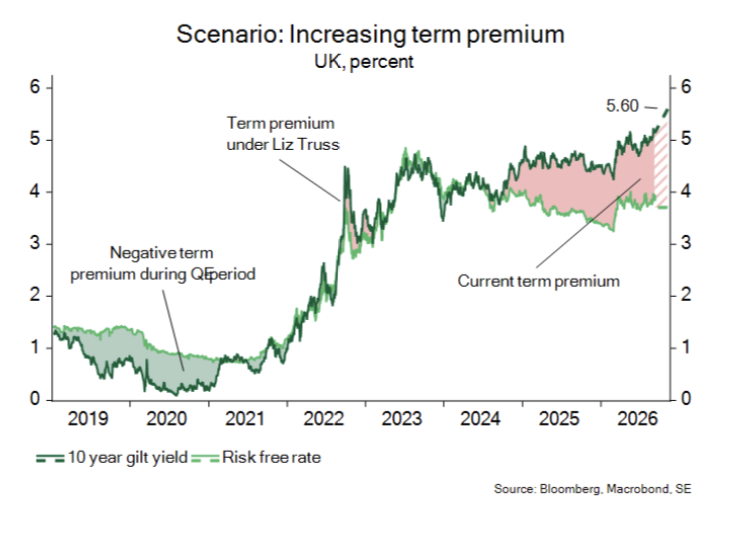
Burnham’s spending ambitions currently exceed the available fiscal space, while long-term UK borrowing costs are already at or above levels reached during the Truss episode. The 28 October Budget is the obvious catalyst in this scenario. Unfunded spending commitments, weaker OBR projections or a material reduction in fiscal headroom could trigger renewed concerns and raise Gilt yields even further. However, given Burnham's stated commitment to the fiscal rules, the larger risk may be greater use of the "flexibility" within them.
However, given the policy agenda, increased debt issuance seems likely. With the ongoing shift in the issuance profile towards shorter and medium maturities, issuance would remain concentrated there, particularly if the BoE eventually resumes rate cuts. At the same time, increased fiscal risk would primarily affect the long end through a higher term premium. The most likely curve reaction would be a bear-steepening, accompanied by weaker a GBP despite higher yields as the fiscal premium increases.
A Liz Truss-style episode remains unlikely, but with debt and yields already high, relatively small policy mistakes could generate sizeable market reactions. As an illustrative case, an equal in size +60bp fiscal-risk repricing would push the 10-year gilt yield towards 5.6%.
2. Easing the cost of living
Burnham has made easing the cost-of-living pressure one of his main priorities. So far, the measures are small, but there are several reasons to continue down this path, with the 2029 general election as the target year. Worldwide, roughly 95% of the incumbent parties during the high inflation year lost voting shares. In UK this was the most important question in the 2024 election, and a major reason for the defeat of the Tory party. The Burnham government is aware of this and has already moved in this direction by both cutting costs and increasing the scrutiny of pricing practices.
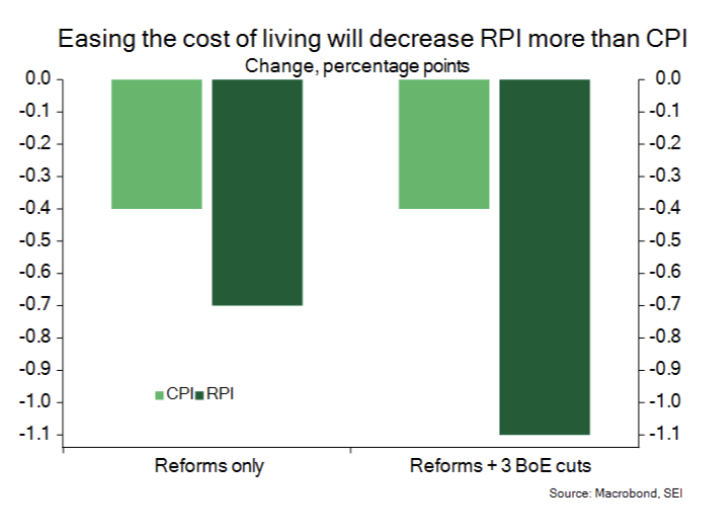
A broader package targeting energy, utilities, housing, transport and food prices could lower CPI by around 0.5pp. The effect on RPI would be larger due to the more household focused composition of the basket. With eventual interest rate cuts, the divergence would increase further.
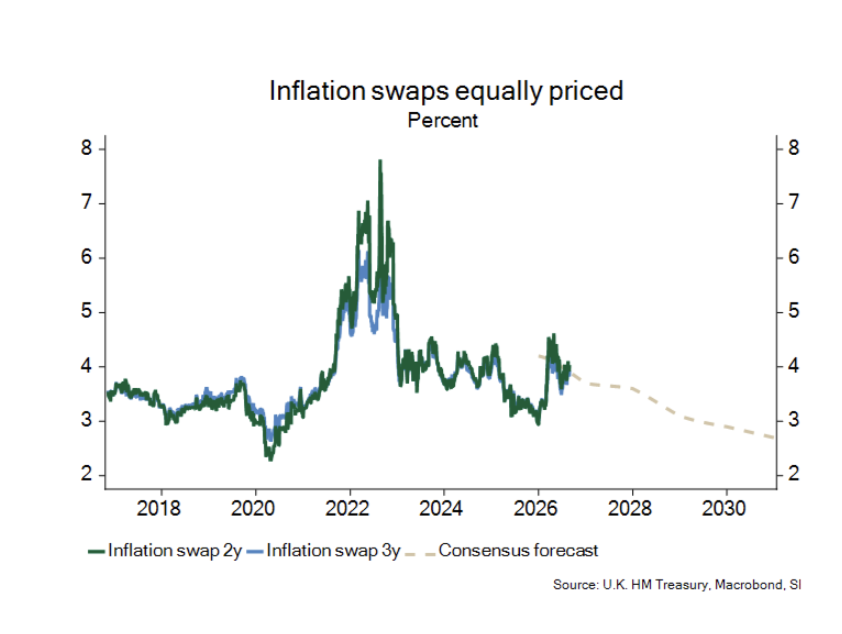
Looking at inflation swaps, which are based on RPI, this scenario is not reflected in current pricing. The 2028 and 2029 swaps imply broadly the same inflation rate, as well as trading well above consensus RPI forecasts. If the government continues to introduce measures aimed at lowering household costs, while interest-rate cuts gradually feed through to mortgage costs, realised RPI inflation should decline over the coming years, with the effect potentially most pronounced in 2029. This makes the flat pricing between 2028 and 2029 particularly interesting, creating scope for a repricing that expresses lower inflation in 2029.
3. Growth case
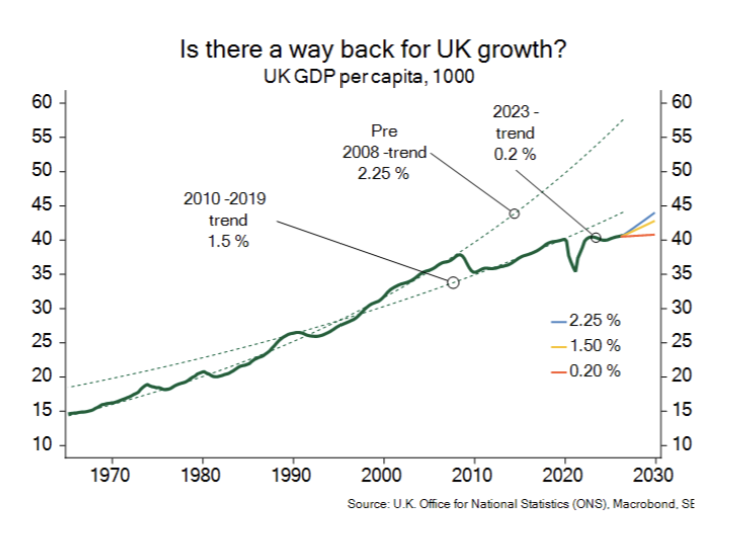
The UK's structural growth problem is well established. Trend GDP-per-capita growth has slowed sharply since the financial crisis and was close to stagnant in the first half of the 2020s, reflecting weak productivity growth, underinvestment, housing constraints, high energy costs and overreliance on London. Fiscal expansion alone will not deliver a sustained increase in trend growth, despite the size of the coming Autumn budget. The more interesting upside is therefore structural: better matching of education and vocational training to labour-market needs, higher youth employment, greater mobility by developing affordable housing and transport, closer EU-collaboration, and increased investments activity from the capital market. The real change is needed to come from making private investments and consumers spending the growth motor.
A credible improvement in growth would strengthen the fiscal outlook by raising revenues and reducing debt ratios. This should reduce the fiscal premium at the long end, while stronger activity keeps expected policy rates higher than otherwise, favouring a flatter yield curve. The combination of stronger fundamentals, improved fiscal credibility and interest-rate differentials, would be positive for GBP.
For UK equities, the growth scenario would provide an important upside case, particularly for more domestically exposed companies that have suffered from weak UK growth expectations. A stronger GBP would be less favourable for internationally exposed companies, making the domestic part of the market the cleaner expression of a UK growth surprise.
However, changing the UK’s growth trajectory is easier said than done and would likely require some support from the BoE to become a more plausible scenario.